The answer, in my opinion, does not lie in one dominating the other, but in a dynamic tension. The artist remains at the centre of the process, but agrees to negotiate their role with the machine, which is no longer a simple tool, but an interlocutor capable of proposing unexpected variations. I am thinking of Marco Donnarumma, who in his works Corpus Nil and Humane Methods stages the coexistence of the body and the algorithm: flesh and code contaminate each other, in a mutual pollution that reveals how fragile the boundary between human and technological is.

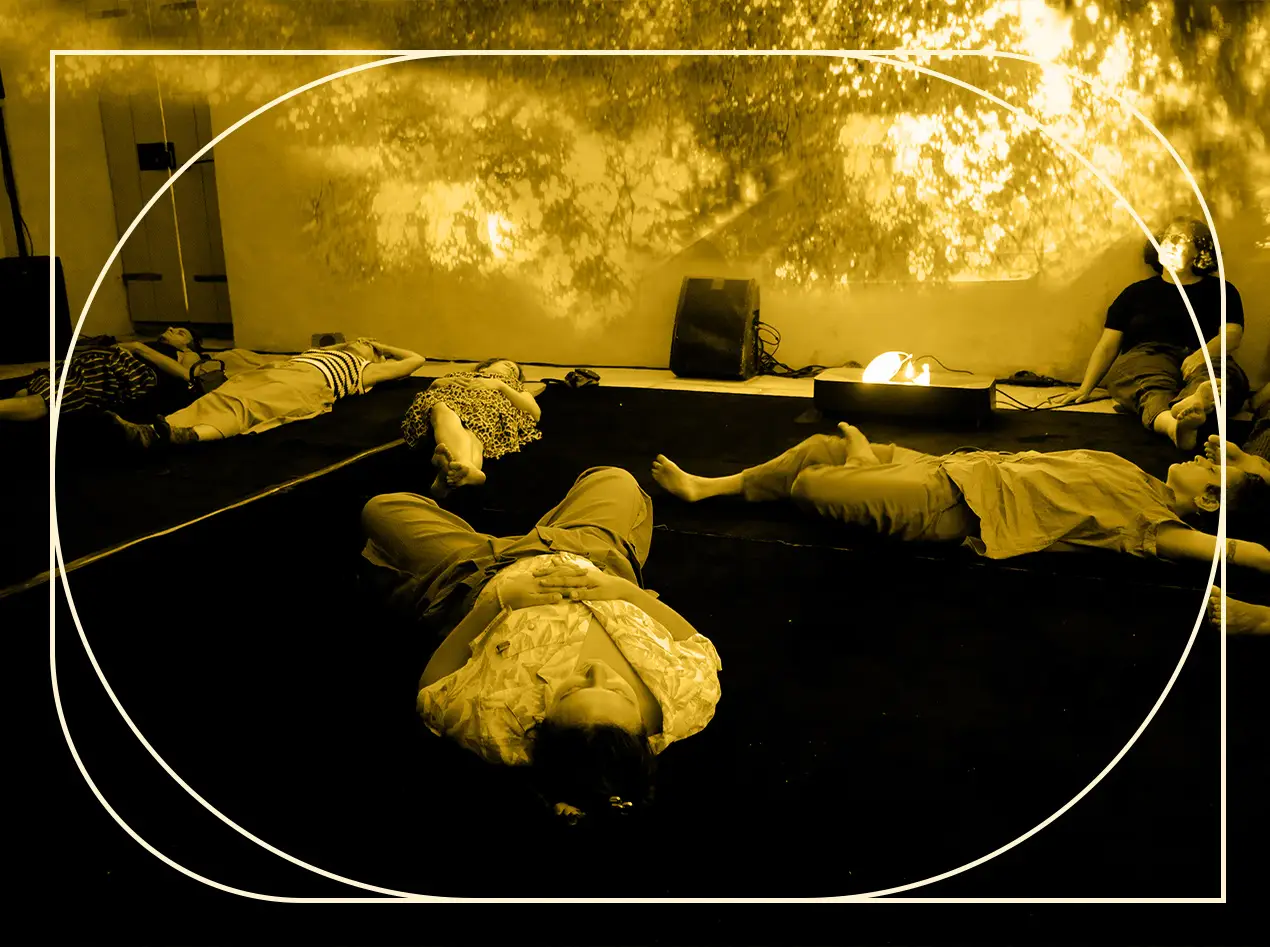
The future of art is therefore shaping up to be an open field of possibilities, rather than a predetermined destiny. It is not machines that are replacing humans, but humans who are reinventing themselves by interpreting the flows generated by machines. Christine Sun Kim, for example, has shown how sound can be translated and reinterpreted beyond hearing, transforming acoustic perception into a tactile, visual and social experience. In Bounce House the artist organises a party where the music is entirely below 20 Hz, below the threshold of human hearing: the sounds processed by technology are not perceived by the ear, but manifest themselves as vibrations in the bones, making the machine a mediator between various sensory dimensions.
This horizon echoes the early insights of Alvin Lucier, who, with I am sitting in a room already showed how sound, repeated and transformed, can reveal the invisible architecture of space. Similarly, Pierre Schaeffer theorised the sound object as an autonomous entity, inviting us to consider sounds not as mere means of expression, but as presences with their own identity.

Technology thus pushes artists to redefine their role. No longer solitary creators, they become directors of complex processes in which human and non-human elements coexist. Kathy Hinde, in her audiovisual installations intertwined with natural ecosystems, shows what can emerge from the intertwining of data, materials and environments, suggesting art as relational ecology. This term was already dear to R. Murray Schafer, the father of acoustic ecology, who had already intuited that the soundscape is a field to be inhabited and transformed responsibly, where art becomes the guardian of the balance between man, environment and technology.
Art is not limited to the act of producing forms, but shifts towards the ability to give meaning to the abundance generated by machines. The challenge is to keep intention, choice and orientation alive. Because if every image can be replicated infinitely, what remains decisive is the human gesture that attributes value and meaning.
I see the art of the future as a hybrid ecosystem, made up of coexistence and tension, of dialogue between sensitivity and automation. It will not be entirely human nor entirely artificial, but will draw its strength precisely from this oscillation between control and loss of control. I think of Richard Brautigan (1967) and his beautiful and visionary All watched over by machines of loving grace, and I am increasingly convinced that the answer lies not in choosing whether man or machine should dominate decision-making processes, but in the coexistence of both, allowing their friction to give rise to beautiful and unexpected worlds.